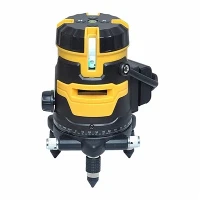

Hey there! As a supplier of Laser Level 3D, I often get asked about the beam divergence of these nifty tools. So, let's dive right in and break it down.
What's Beam Divergence Anyway?
Beam divergence is a key concept when it comes to lasers, including those in Laser Level 3D devices. Simply put, it's the angle at which a laser beam spreads out as it travels away from the source. You can think of it like a flashlight beam. When you shine a flashlight close to a wall, the spot is small and concentrated. But as you move the flashlight further away, the spot gets bigger and more spread out. That's beam divergence in action.
In the context of a Laser Level 3D, beam divergence affects how accurate and useful the laser lines are at different distances. A lower beam divergence means the laser beam stays more focused over a longer distance, which is great for precise measurements and leveling work.
Why Does Beam Divergence Matter for Laser Level 3D?
Let's say you're working on a large construction project, like building a multi - story building or a big retaining wall. You need your laser level to be accurate over long distances. If the beam divergence is too high, the laser lines will spread out quickly, and you won't get an accurate reading. This can lead to costly mistakes in your project.
For example, if you're using a Laser Level for Retaining Wall, you need the laser to be precise along the entire length of the wall. A high beam divergence could cause the laser line to deviate from the intended path, resulting in an uneven wall.
On the other hand, a Laser Level 3D with a low beam divergence can maintain a narrow and accurate laser line over a long distance. This allows you to work with greater precision, whether you're doing indoor leveling, outdoor construction, or any other application that requires accurate measurements.
How is Beam Divergence Measured?
Beam divergence is typically measured in milliradians (mrad). One milliradian is equal to 0.0573 degrees. A smaller mrad value means less beam divergence. For example, a laser with a beam divergence of 1 mrad will spread out less than a laser with a beam divergence of 2 mrad.
Most high - quality Laser Level 3D devices have a beam divergence in the range of 0.5 to 2 mrad. The exact value depends on the design and quality of the laser source used in the device.
Factors Affecting Beam Divergence in Laser Level 3D
There are several factors that can affect the beam divergence of a Laser Level 3D. The first is the quality of the laser diode. Higher - quality diodes tend to have lower beam divergence because they can produce a more focused beam.
The optical system in the laser level also plays a crucial role. A well - designed optical system can help to collimate the laser beam, reducing its divergence. This includes lenses and other optical components that are carefully calibrated to ensure the beam stays as narrow as possible.
Environmental conditions can also impact beam divergence. For example, dust, humidity, and temperature can all cause the laser beam to scatter and spread out more than normal. That's why it's important to use your Laser Level 3D in the appropriate conditions and take steps to protect it from the elements.
Comparing Beam Divergence in Different Laser Levels
When you're in the market for a Laser Level 3D, it's important to compare the beam divergence of different models. Some entry - level models may have a higher beam divergence, which can limit their accuracy over long distances. On the other hand, more professional - grade models often have a lower beam divergence, making them better suited for large - scale projects.
If you're working on a small - scale project, like hanging pictures or doing some basic home improvement, a laser level with a slightly higher beam divergence may be sufficient. But for more complex and precise work, such as construction or surveying, you'll want to invest in a laser level with a lower beam divergence.


Applications and Beam Divergence
The beam divergence of a Laser Level 3D also affects its suitability for different applications. For example, if you're using a Laser Level Multiple Lines for indoor leveling, a slightly higher beam divergence may not be a big deal. Since the distances are usually shorter indoors, the laser lines will still be relatively accurate.
However, for outdoor applications, such as land surveying or large - scale construction, a low beam divergence is essential. The longer distances involved mean that even a small amount of beam divergence can result in significant errors.
Making the Right Choice
As a supplier, I always recommend that customers consider their specific needs when choosing a Laser Level 3D. If you're not sure what beam divergence is right for you, think about the type of projects you'll be working on, the distances involved, and the level of precision you require.
If you're new to using laser levels, it might be a good idea to start with a mid - range model and see how it works for you. As you gain more experience and take on more complex projects, you can upgrade to a higher - end model with a lower beam divergence.
Conclusion
In conclusion, beam divergence is a critical factor to consider when choosing a Laser Level 3D. It affects the accuracy and usefulness of the laser lines, especially over long distances. By understanding beam divergence and how it impacts your work, you can make an informed decision when purchasing a laser level.
If you're interested in learning more about our Laser Level 3D products or have any questions about beam divergence, feel free to reach out. We're here to help you find the right laser level for your needs. Whether you're a professional contractor or a DIY enthusiast, we've got the tools to make your projects a success. So, don't hesitate to contact us for more information and to start a purchase negotiation.
References
- Laser Physics textbooks
- Manufacturer's specifications for Laser Level 3D devices