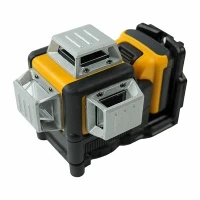

Can I use an indoor laser level for tiling?
Tiling is a meticulous and skill - intensive task that requires precision to achieve a professional and aesthetically pleasing finish. One of the tools that can significantly aid in this process is an indoor laser level. As a supplier of Indoor Laser Level, I am often asked whether an indoor laser level can be used for tiling. In this blog, we will explore the feasibility, advantages, and limitations of using an indoor laser level for tiling.
Feasibility of Using an Indoor Laser Level for Tiling
An indoor laser level is indeed suitable for tiling. These devices emit a highly visible laser beam that can create straight and accurate reference lines on walls, floors, or ceilings. When tiling, these reference lines serve as guides to ensure that the tiles are laid in a straight and level manner.


For example, when tiling a bathroom wall, an indoor laser level can project a horizontal line to mark the height at which the tiles should be installed. This helps in keeping all the tiles at the same height, preventing unevenness and creating a smooth and uniform appearance. Similarly, vertical lines can be projected to ensure that the tiles are aligned properly from top to bottom.
Advantages of Using an Indoor Laser Level for Tiling
- Precision and Accuracy
The primary advantage of using an indoor laser level for tiling is the high level of precision it offers. Laser beams are extremely straight, and they can create perfectly horizontal and vertical lines. This precision is difficult to achieve manually, especially over large areas. With a laser level, you can ensure that your tiles are installed with minimal gaps and a consistent alignment, resulting in a professional - looking finish. - Time - Saving
Using an indoor laser level can significantly reduce the time required for tiling. Instead of spending a lot of time measuring and marking reference lines with a tape measure and a pencil, the laser level can quickly project the necessary lines. This allows you to start tiling faster and complete the project more efficiently. - Ease of Use
Indoor laser levels are relatively easy to operate. Most models come with simple controls that allow you to turn the laser on and off, adjust the angle of the beam, and even switch between horizontal and vertical lines. Even novice tilers can quickly learn how to use an indoor laser level to achieve accurate results. - Versatility
In addition to tiling, an indoor laser level can be used for a variety of other tasks, such as hanging pictures, installing shelves, and aligning furniture. This makes it a valuable tool for both DIY enthusiasts and professional contractors.
Limitations of Using an Indoor Laser Level for Tiling
- Lighting Conditions
Indoor laser levels are designed for use in indoor environments. In bright sunlight or in areas with high - intensity lighting, the laser beam may be difficult to see. This can limit the effectiveness of the laser level, especially when working near windows or in well - lit areas. - Range and Coverage
The range and coverage of an indoor laser level may be limited. Some models have a maximum range of only a few meters, which may not be sufficient for large - scale tiling projects. In such cases, you may need to move the laser level multiple times to cover the entire area, which can be time - consuming. - Surface Conditions
The laser beam may not be clearly visible on certain surfaces, such as highly reflective or textured materials. For example, if you are tiling a wall with a shiny ceramic tile, the laser beam may be reflected, making it difficult to see the reference line. In such cases, you may need to use additional techniques, such as masking tape, to mark the reference lines.
Types of Indoor Laser Levels for Tiling
- Line Laser Levels
Line laser levels project a single or multiple laser lines on a surface. These lines can be horizontal, vertical, or both. Line laser levels are ideal for tiling because they can create clear reference lines for tile installation. Indoor Laser Level is a great option for tiling projects, as it offers accurate and visible laser lines. - Dot Laser Levels
Dot laser levels project a series of laser dots on a surface. These dots can be used to mark specific points or to create a grid pattern. While dot laser levels are not as commonly used for tiling as line laser levels, they can be useful for marking the corners or edges of tiles. - Rotary Laser Levels
Rotary laser levels project a 360 - degree laser beam around a room. This type of laser level is suitable for large - scale tiling projects, as it can cover a wide area with a single setup. However, rotary laser levels are typically more expensive than line or dot laser levels.
Tips for Using an Indoor Laser Level for Tiling
- Choose the Right Laser Level
Consider the size of your tiling project, the lighting conditions, and your budget when choosing an indoor laser level. For small - scale projects, a basic line laser level may be sufficient. For larger projects or more complex tiling patterns, a rotary laser level may be a better choice. - Set Up the Laser Level Correctly
Make sure the laser level is placed on a stable surface and is level itself. Use a spirit level to check the alignment of the laser level. Once the laser level is set up, adjust the angle and height of the laser beam to create the desired reference lines. - Use Additional Tools
In addition to the laser level, you may need to use other tools, such as a tile cutter, a trowel, and a level. These tools can help you cut the tiles to the correct size and ensure that they are installed at the right angle. - Check the Laser Beam Regularly
During the tiling process, check the laser beam regularly to make sure it is still accurate. If the laser level is moved or bumped, the reference lines may be affected. Make any necessary adjustments to the laser level to maintain the accuracy of the reference lines.
Conclusion
In conclusion, an indoor laser level can be a valuable tool for tiling. It offers precision, accuracy, and time - saving benefits, making it a popular choice among DIY enthusiasts and professional contractors. However, it is important to be aware of the limitations of indoor laser levels, such as lighting conditions and range. By choosing the right laser level and following the tips mentioned above, you can achieve professional - looking results in your tiling projects.
If you are interested in purchasing an indoor laser level for your tiling project, or if you have any questions about our products, we invite you to contact us for a procurement discussion. We offer a wide range of high - quality Indoor Laser Level, Outdoor Laser Level with Tripod, and Digital Display Green Laser Level to meet your specific needs.
References
- "Laser Levels: A Guide to Choosing the Right One." Home Improvement Magazine.
- "Tiling Techniques for Beginners." DIY Tiling Handbook.